
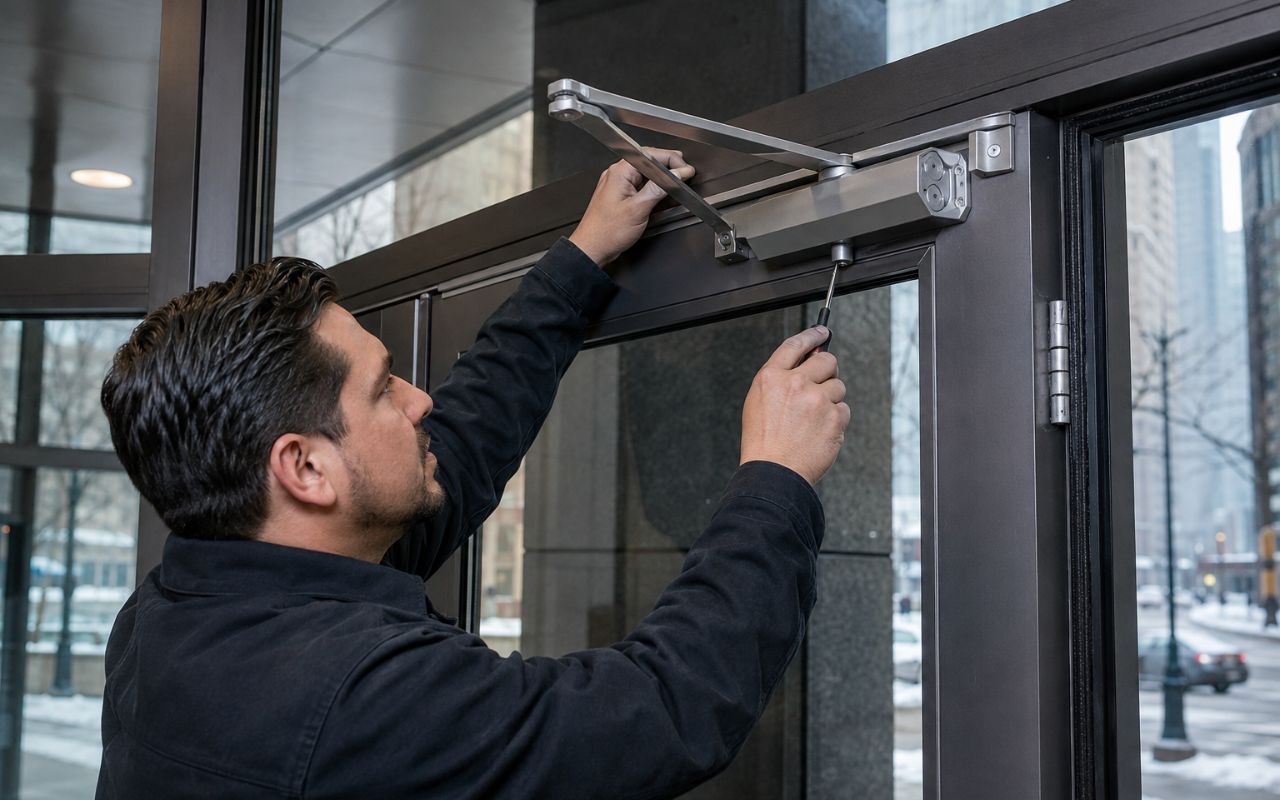
Commercial door closer adjustment works correctly when spring tension, closing speed, latch speed, and ADA limits are balanced. The goal is simple: the door should close securely without slamming, sticking, or creating access problems for customers, staff, or visitors.
Chicago weather, heavy foot traffic, and daily use can turn a smooth entry door into a noisy problem. If your closer slams, drags, or fails to latch, a careful adjustment may help.
For a deeper guide, review our commercial door closer guide before making changes.
Start With a Safe Door Closer Inspection
A door closer controls how a commercial door moves after someone opens it. Property managers, store owners, and building teams need adjustment when doors close too fast, stay open, or miss the latch.
Proper closer settings can reduce noise, improve safety, support access, and limit wear before parts fail. At Chicago Door People, we check the closer body, arm, screws, hinges, frame, and latch before changing settings.
A closer can seem weak when the real issue is a loose arm, worn hinge, or shifted frame. That is why the first inspection step matters.
Common Door Closer Problems
- Slamming doors may need slower sweep speed.
- Doors that stop short may need latch speed changes.
- Heavy pull can point to spring tension issues.
- Leaking fluid usually means replacement or repair is needed.
Small adjustments should always be tested after each turn. If the closer leaks fluid, adjustment screws will not fix the failure.
Adjust Spring Tension With Care
Door closer spring tension adjustment controls how much force pulls the door closed. Too much tension can make the door hard to open.
Too little tension can stop the door from latching, especially on busy exterior entrances. Most closers use a spring inside the closer body.
Turning the spring adjustment in small steps can change the closing force. However, every model is different. We recommend quarter turns, followed by a full open-and-close test.
Spring Tension Decision Check
- Increase tension when the door will not latch.
- Reduce tension when opening force feels too heavy.
- Check hinges before assuming the closer is weak.
- Stop adjusting if the closer makes grinding sounds.
With Chicago Door People, customers can ask us to review closer force when the door feels unsafe, loud, or difficult to use.
Key Takeaway
A door closer should not be adjusted blindly. Inspect the closer, hinges, arm, frame, latch, and leaks before changing spring tension or speed settings.
Compare Door Closer Problems and Next Steps
Different closer symptoms can point to different causes. A simple comparison helps building teams understand when adjustment may help and when repair is the better choice.
Commercial Door Closer Adjustment Guide
| Door Problem | Possible Cause | Helpful Next Step |
|---|---|---|
| Door slams shut | Sweep speed or latch speed may be too fast. | Adjust speed screws in small turns and test. |
| Door will not latch | Latch speed, spring force, hinges, or alignment may be off. | Check hardware before increasing spring tension. |
| Door is hard to open | Spring tension may be too strong or hinges may bind. | Review opening force and closer settings. |
| Closer leaks oil | Internal seals may have failed. | Schedule repair or replacement instead of adjusting. |
| Door closes too quickly for access | ADA timing may not be met. | Check closing time from 90 degrees to 12 degrees. |
Set Door Closer Speed for Chicago Entrances
Learning how to adjust door closer speed in Chicago helps building teams handle seasonal door changes. Cold weather can make hydraulic movement feel slower, while frequent use can loosen settings over time.
The door should close smoothly without startling people. Most commercial closers include sweep speed and latch speed screws.
The sweep speed controls most of the closing path. The latch speed controls the last few inches before the door meets the frame.
According to the U.S. Access Board, door closers on accessible routes need enough closing time for safe passage. Use small changes because a full turn can create new problems.
Turn the speed screw clockwise to slow movement on many models. Turn it counterclockwise to speed movement. Then test from a normal open position.
For related help, review our door closer repair options when speed changes do not solve the issue.
Key Takeaway
Sweep speed controls most of the closing path. Latch speed controls the final inches. Both settings should be adjusted slowly and tested after each change.
Review ADA Door Closer Settings
ADA door closer settings help make doors easier and safer for people using wheelchairs, walkers, canes, or mobility aids. A closer should not pull the door shut too quickly while someone is still passing through the opening.
The U.S. Access Board explains that door closers should take at least five seconds to move from 90 degrees to 12 degrees from the latch. This rule helps improve access on compliant routes.
Closing speed is not only a comfort issue. It can affect usability, safety, and access for people moving through commercial entrances.
ADA Timing Check
- Open the door to about 90 degrees.
- Release the door without pushing it.
- Time the movement toward 12 degrees.
- Adjust speed until the door closes safely.
Our team can review ADA-related closer concerns during a door check. You can also read our ADA closer requirements for more guidance.
Know When Repair Is Better Than Adjustment
A repair review helps confirm whether the closer needs adjustment, repair, or replacement. When settings no longer respond, the problem may involve worn seals, loose hardware, damaged arms, poor alignment, or a closer that has reached the end of its useful life.
When customers contact Chicago Door People, we ask what the door is doing, when the issue started, and whether the door is interior or exterior.
We may also ask about slamming, leaking fluid, latch failure, or heavy opening force.
Door Closer Repair Review
- Inspect the closer body and mounting points.
- Check the hinges, frame, arm, and latch.
- Test sweep speed and latch speed.
- Explain safe repair or replacement options.
NFPA notes that fire doors must be operable and able to close and latch when required. If your door is part of a fire-rated assembly, do not wedge it open or ignore latch problems.
Key Takeaway
Adjustment cannot fix every closer problem. Leaks, stripped screws, bent arms, worn seals, and fire-door latch issues usually need professional repair review.
Frequently Asked Questions
Can I adjust a commercial door closer myself?
Yes, minor speed or tension changes can often be done with basic tools. Make small quarter-turn adjustments and test the door each time. If the closer leaks, binds, or will not respond, schedule professional closer repair.
Why does my door closer slam after adjustment?
A door may slam when the sweep speed or latch speed is too fast. It may also slam if the closer has worn seals or damaged valves. Slamming should be corrected quickly because hard impact can damage frames, locks, and glass.
What tools are needed for closer adjustment?
Most adjustments need a screwdriver, hex key, and sometimes an adjustable wrench. A timer helps check ADA timing. Before turning screws, compare your closer style with our closer adjustment instructions.
When should I stop adjusting the door closer?
Stop adjusting if the closer leaks oil, the screws feel stripped, the arm is bent, or the door still misses the latch. These signs usually point to repair needs. Repeated turning can make damage worse and may reduce safe door control.
Who checks ADA door closer settings in Chicago?
Building owners, managers, and service professionals may review closer timing on accessible routes. If you are unsure about the five-second timing rule, start with our accessibility closer guidance and request help when settings feel unclear.
Fix Door Closer Problems Before They Spread
Small closer problems often grow when doors are used all day. With Chicago Door People, you can get practical guidance before damage spreads.
For help with commercial door closer adjustment, repair review, or safer entry performance, reach us through our contact our door team page.