
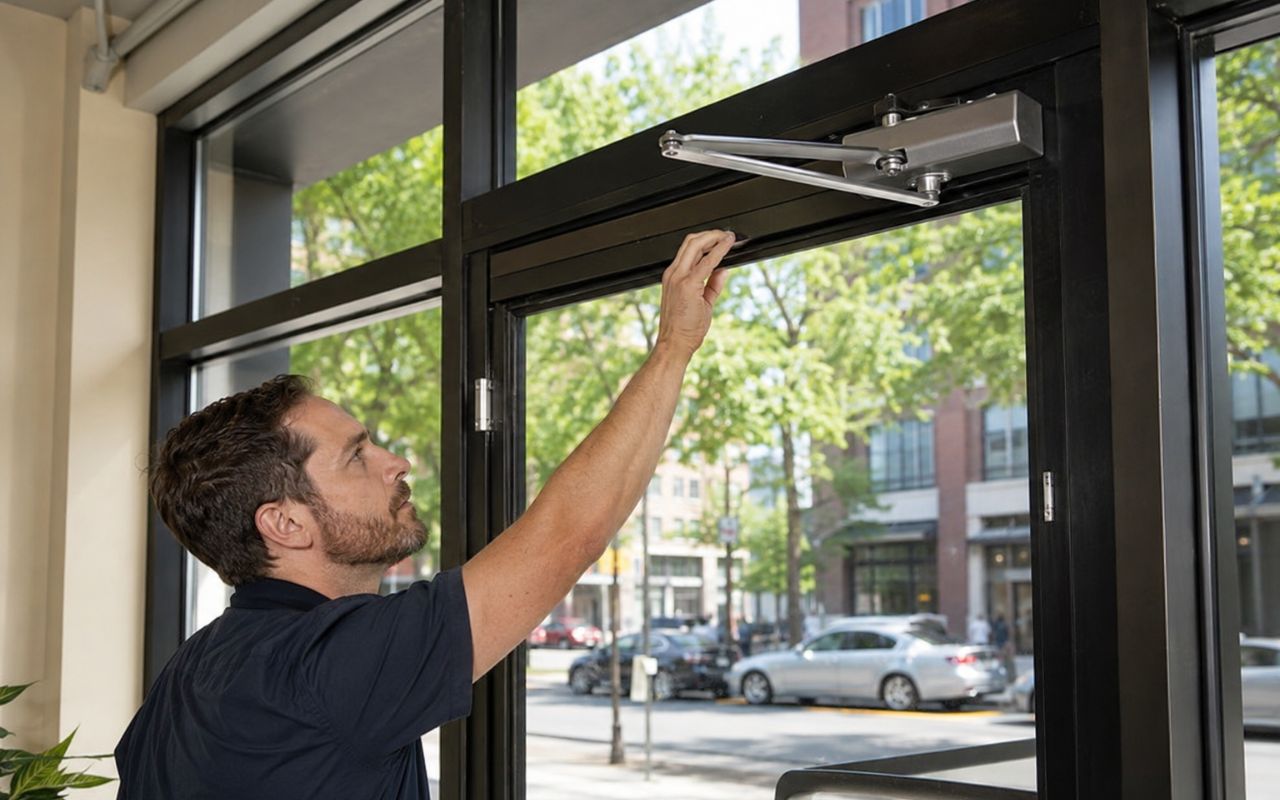
Heavy Chicago foot traffic, winter weather, and busy storefront entries can make one stiff door a real access barrier. At Chicago Door People, we check closer force, swing speed, hardware height, and entry clearance before recommending repairs, adjustments, or installation. Because ADA door closer requirements Chicago commercial questions affect real entry use, you can start with accessible entrance planning.
What ADA door closer requirements Chicago commercial buildings follow?
ADA door closer requirements Chicago commercial owners should understand include opening force, closing speed, clear width, hardware reach, thresholds, and automatic opener controls. The goal is simple: doors should open with reasonable effort, close safely, and let customers enter without tight grasping, twisting, rushing, or unclear access points.
A commercial door closer controls how a door opens, slows down, and latches after use. Businesses that need ADA compliant commercial door installation in Chicago often need this work when doors feel heavy, close too fast, slam, drag, or make entry harder for customers using mobility aids.
ADA door closer requirements Chicago commercial checks reduce access risks
A useful compliance check begins with the full door opening, not only the closer. We review the force needed to open the door, the time it takes to close, the latch action, the threshold, the handle height, and the clear space around the entry.
The U.S. Department of Justice lists door closer timing, hardware operation, and opening force as measurable access items. When customers call Chicago Door People, we look at the whole opening, not only the closer arm. If the door closes too fast, our closer adjustment steps can help explain the basic issue.
- Opening force should be tested with the door unlatched.
- Closing speed should allow safe passage without rushing.
- Door hardware should not require tight grasping or twisting.
- Threshold height should not create a trip or roll barrier.
Chicago code reviews protect every accessible entrance decision
Chicago building code door compliance should be checked with ADA rules because both can affect a commercial opening. A door may need the right width, landing space, hardware height, threshold condition, swing clearance, fire rating, or automatic operator setup before the entrance works well.
ICC Digital Codes publishes Chicago Building Code accessibility chapters that address doorways and accessible routes. However, Chicago permit review is not the same as a full ADA legal review. That is why we recommend documenting measurements, repairs, and adjustments. For doors that already feel hard to control, closer repair support can prevent small issues from turning into failed access.
Opening force testing keeps doors usable for visitors
Opening force testing helps managers understand whether a door can be used by people with limited strength, walkers, wheelchairs, strollers, or deliveries. Many people search ADA door opening force requirements commercial 2026 because they want current, measurable checks before inspections or repairs.
Interior accessible doors generally need low opening force, while exterior and fire-rated doors may require review by the proper authority. With Chicago Door People, you can ask for measurements before deciding whether adjustment, repair, replacement, or an automatic operator makes the most sense.
- Test the door after unlatching, not while the latch is resisting.
- Watch the full swing for drag, binding, or frame contact.
- Check the latch speed so the door closes without slamming.
- Record each result for future maintenance notes.
Automatic opener planning improves safer entry for customers
Automatic operators can improve access when a manual door remains difficult after proper adjustment. Automated door opener ADA requirements still include clear width, threshold review, controls, safety sensors, maneuvering space, and placement that keeps users outside the swing path.
Power-assisted and low-energy doors can help customers who cannot comfortably pull a heavy commercial door. Still, an opener does not fix every problem. A weak frame, damaged hinges, uneven threshold, or bad latch can affect performance. We check these items first because safe automation depends on the whole door assembly.
Clear booking steps prepare your property for compliance
A clear review process helps you understand what needs repair, what needs adjustment, and what may need replacement. When a property manager contacts Chicago Door People, we first ask about the door location, traffic level, current problem, photos if available, and any recent inspection concerns.
After that, the appointment focuses on practical measurements and plain guidance. We avoid guessing from one symptom because a heavy door may come from the closer, hinges, frame, threshold, latch, or weather conditions.
- Share the access concern, such as force, speed, or hardware height.
- Review the opening for clearance, threshold, latch, and closer action.
- Explain the options before repair, adjustment, or installation begins.
- Keep simple records of completed work and future checks.
Frequently Asked Questions
What force should interior accessible doors use in 2026?
Interior accessible doors should generally stay within the ADA’s five-pound opening force limit after the latch is released. For a broader Chicago checklist, review accessible entrance planning before scheduling repairs or installation work in 2026.
Why can a compliant door still feel too heavy?
A door may feel heavy because of hinge wear, frame pressure, weather seals, floor rubbing, latch resistance, or a closer set too strong. The opening force test should separate latch resistance from the force needed to keep the door moving.
When should commercial closers be adjusted or replaced?
Adjust a commercial closer when the door slams, closes too slowly, does not latch, or needs too much force. Replace it when leaking, damaged, worn, or unable to hold settings. Our closer repair support can help identify the next step.
Can automatic openers solve every accessibility problem alone?
No. Automatic openers can reduce manual effort, but the door still needs proper width, threshold condition, sensor safety, clear floor space, and dependable hardware. If the frame or hinges are damaged, repair should come before automation.
Do Chicago businesses need documentation after door repairs?
Documentation helps show that the business checked force, closing speed, hardware, and repairs over time. Keep notes, photos, invoices, and inspection results. To discuss your opening, use request a door review and share the concern clearly.
Request practical guidance before door access problems grow
Door access issues are easier to solve before customers struggle or inspections create pressure. When you contact Chicago Door People, we can review the concern, explain practical options, and help you plan the next step. Use request a door review to start with clear information.